The Human
Effectiveness Code
You can live life by design or by default. By choice or by chance. You can make things happen — or just let things happen. Come discover how you are the architect of your life, and choose to build one that's extraordinary.
A code, not a formula
Have you ever wondered how some individuals have acquired the ability — with insight and wisdom — to make more informed decisions and take unique actions that consistently produce meaningful and lasting results in all areas of their life? They have acquired the ability to move from living a life by default to a life crafted by design — a life that becomes the foundation for their effectiveness as fully functioning human beings.
What about you? Are you leading a life that's purposeful? Are you living a life that has meaning? Are you living in alignment with a set of defined values that guide and direct your life? Or are you living by someone else's script . . . someone else's definition of success? After having been in leadership roles and consulting for over 25 years, I have discovered the "code" for increasing one's effectiveness.
The Human Effectiveness Code will guide you through seven simple, actionable steps that achieve predetermined, desirable outcomes. You will move from living life day by day to becoming the author and architect of your life — able to create your own lasting legacy. Unlike most self-help books, this one doesn't just talk about what you should do to change. It contains the strategy and foundation for change — the why, what, when, and most importantly the how.
What you'll have accomplished by the end of the book:
- 01Easily understand and apply the seven components for living a life with purpose based on design, not default.
- 02Have the "keys" to becoming the architect of your life.
- 03Understand you do not need degrees, citations, or a license.
- 04Choose the kind of legacy you would like to create and leave for yourself and others.
- 05Have the capacity to move from a life that is ordinary to one that is extraordinary.
The Seven Steps
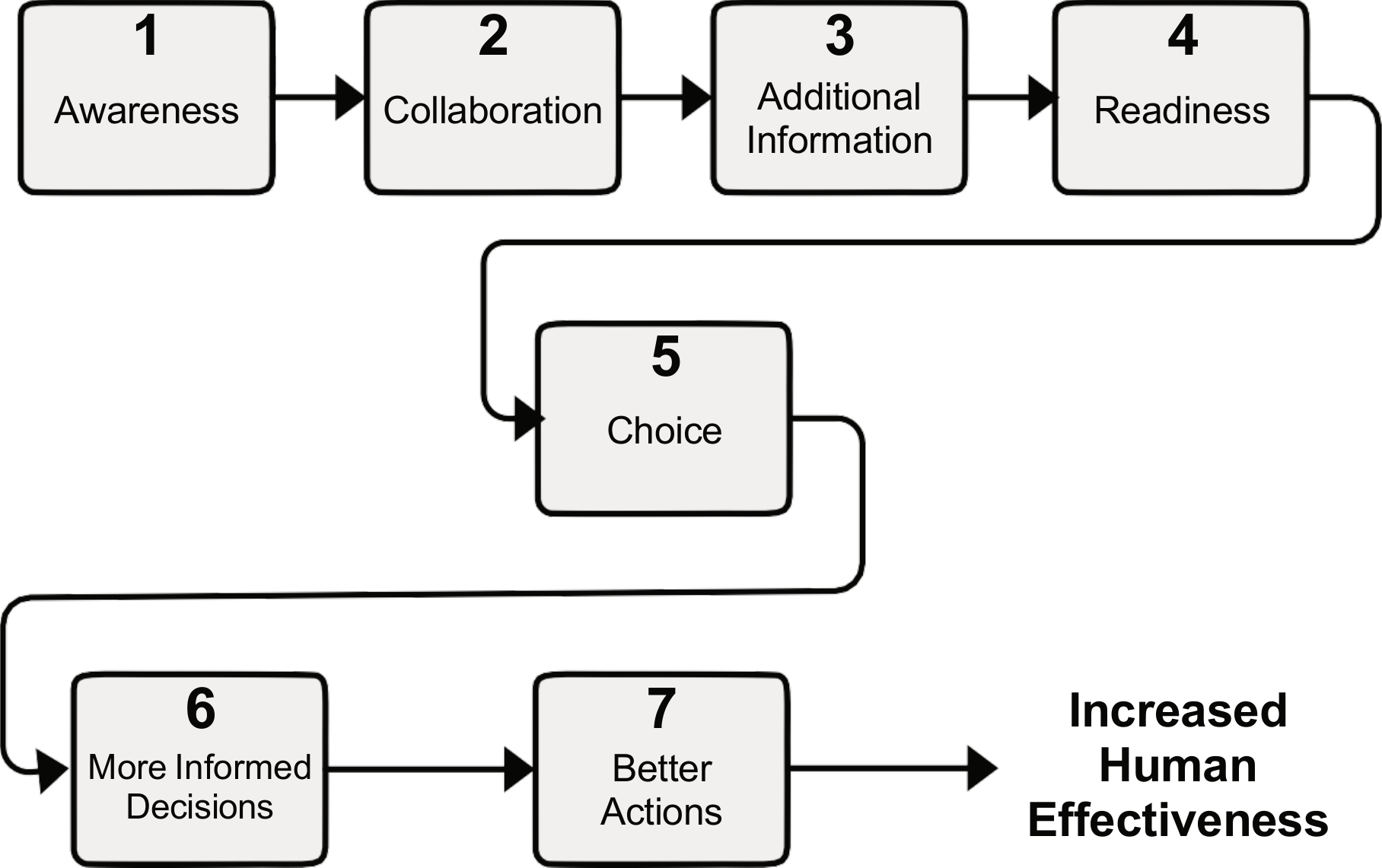
Seven interconnected components form a progressive flow — from internal understanding to external effectiveness. Each one builds on the others to create sustainable, intentional growth.
Awareness
Becoming conscious of your thoughts, emotions, behaviors, and actions. Being self-aware includes understanding your own feelings, values, and beliefs.
Collaboration
Inviting feedback, perspective, and insight from others to deepen awareness and accelerate learning.
Additional Information
Seeking out new knowledge, data, and perspectives to broaden your understanding.
Readiness
Reaching a personal and mental state where change is not only possible, but welcome — where you're willing to make the choice to grow.
Choice
Exercising the power to select actions that align with your values, priorities, and goals. The greatest power we have as a "human becoming" is the power to choose.
More Informed Decisions
Making better decisions because of clarity, context, and discernment.
Better Actions
Engaging in behavior that is deliberate, effective, and aligned with your desired outcomes.
From the Book
From the Introduction
The way you think determines the way you feel, and the way you feel determines the way you act. If you want to change how you act, you must begin by changing the way you think.
— Rick WarrenWe have what's called the Reticular Activating System (RAS). It is the brain's natural attention filter. Every moment, your five senses receive an overwhelming amount of information. Without a filtering system, you would quickly experience information overload.
How Affirmations (Self-Talk) Influence the RAS — When you repeatedly think and focus on an idea, you signal to your brain that this idea is important. The RAS then begins to allow information, opportunities, and experiences that support that focus to get through your filter. For example, if you affirm, "I am surrounded by supportive people," your RAS naturally notices acts of kindness, encouragement, and cooperation — and lets it through. In this way, how you think and what you focus on shapes what your mind allows you to see.
Here's how our mental process works:
Start your seven steps
Available in hardcover, paperback, and ebook.

Skip Wilkins
Skip Wilkins is President of Integrated Performance Systems and has over 30 years of dynamic leadership and consulting experience creating organizational environments that maximize results by successfully integrating people, performance, and productivity. He brings expertise in consulting, training and facilitation, business operations, customer and client relations, and performance management — recognized for partnering with clients in a way that builds strong relationships and client-centered results.
Skip has served for over 15 years as an Adjunct Professor of graduate studies at the University of Phoenix, focused on Organizational Leadership, Human Capital Management, Ethics in Management, and Critical Thinking. His experience also includes serving as an Associate with the Edge Learning Institute, an international human development firm. His passion for human performance began in 1972 as an Executive in Human Resources with the Salt River Project, where he led a team of 90 HR professionals across development, training, employee relations, and performance management. Skip is owner/co-founder of the Wilkins Learning Corporation, which provides educational opportunities through the award-winning Wilkins Learning Center. He holds a Master of Arts in Industrial & Organizational Psychology and a Bachelor of Science in Psychology from Western Michigan University, with doctoral coursework completed at Arizona State University in Educational Psychology. He can be reached at swilk44@msn.com.
Notes on Effectiveness
Short reflections drawn from the book — the place readers come back to between chapters.
You Can't Change What You Won't See
Awareness isn't self-criticism — it's the first honest look at your own thoughts, values, and blind spots. It's uncomfortable, and it's the doorway every other step depends on.
Read the post →Life by Design, Not by Default
There's a difference between drifting through your days and architecting them on purpose. Here's what it actually takes to become the author of your own life instead of a character in someone else's script.
Read the post →Why I Wrote This After 30 Years in the Room
Three decades of leadership and consulting taught me the same lesson over and over: capable people stay stuck for reasons that have nothing to do with capability. Here's the moment that turned into this book.
Read the post →Get the Introduction, free
Join the list and get the Introduction the moment you sign up, plus first word on the launch, events, and new journal posts.
Prefer not to sign up? Download the Introduction (PDF) instantly, no email required.